


 HY-TS013BA_Silicone PSA Black Anti-static PTFE Film Tape – Technical Data Sheet.pdf
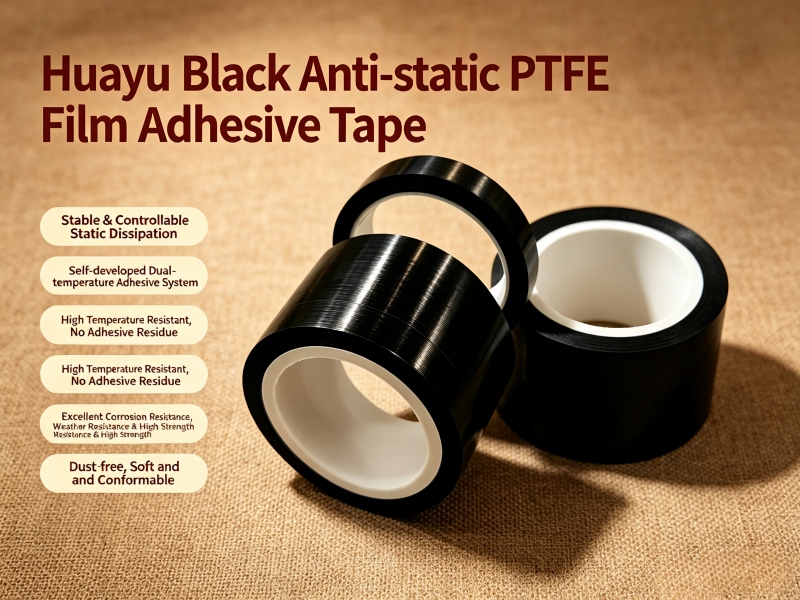
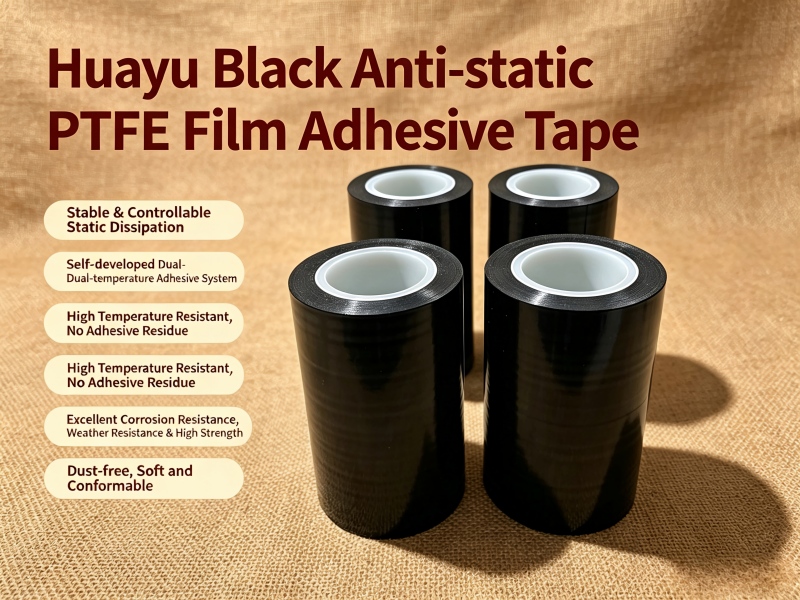
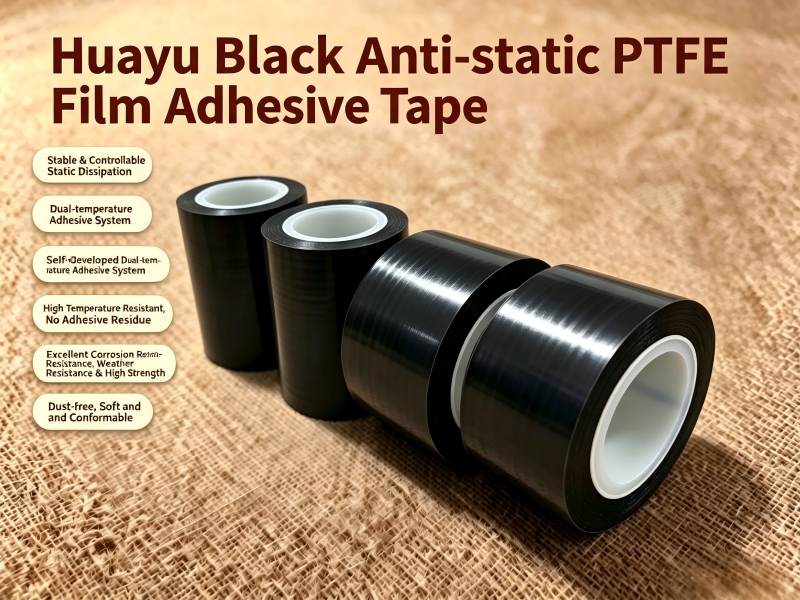
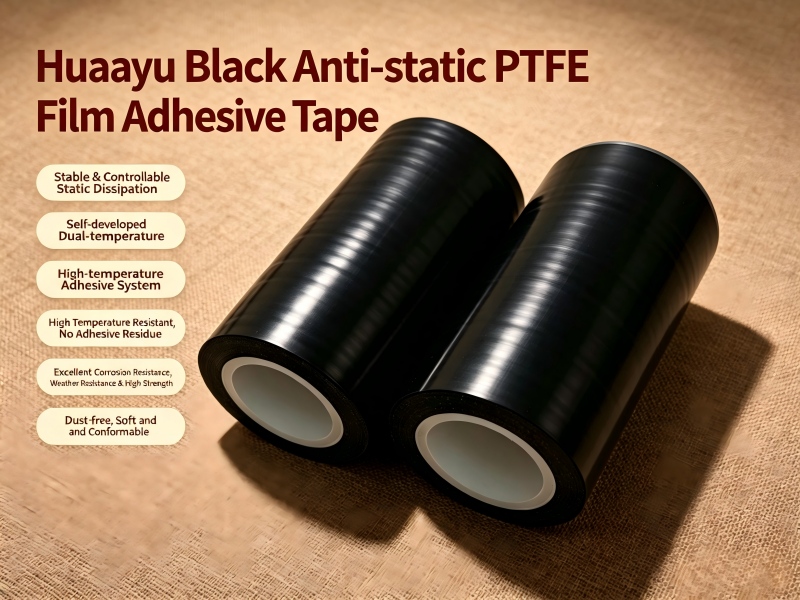
Huayu Black Anti-Static PTFE Film Adhesive Tape is manufactured from modified anti‑static high‑purity PTFE film with evenly dispersed conductive filler inside substrate. Its surface resistance is stably controlled uniformly from 10⁷‑10⁸ ohm per square, avoiding random fluctuation of anti‑static performance. Single‑side pressure‑sensitive adhesive coating offers three adhesive options: conventional acrylic PSA (150 °C), self‑formulated high‑temperature‑resistant acrylic PSA (260 °C, formula benchmarked against Henkel Germany), and silicone pressure‑sensitive adhesive.
This tape integrates static‑dissipation, high‑temperature resistance, non‑stick release and anti‑corrosion performance. Made of solid film without fiberglass substrate, it features good flexibility for conformable lamination and eliminates fiberglass particle‑shedding risk. It is a special‑purpose industrial tape for static‑charge dissipation in electronic processes, clean‑rooms and chemical equipment, serving as ideal import‑substitute material.
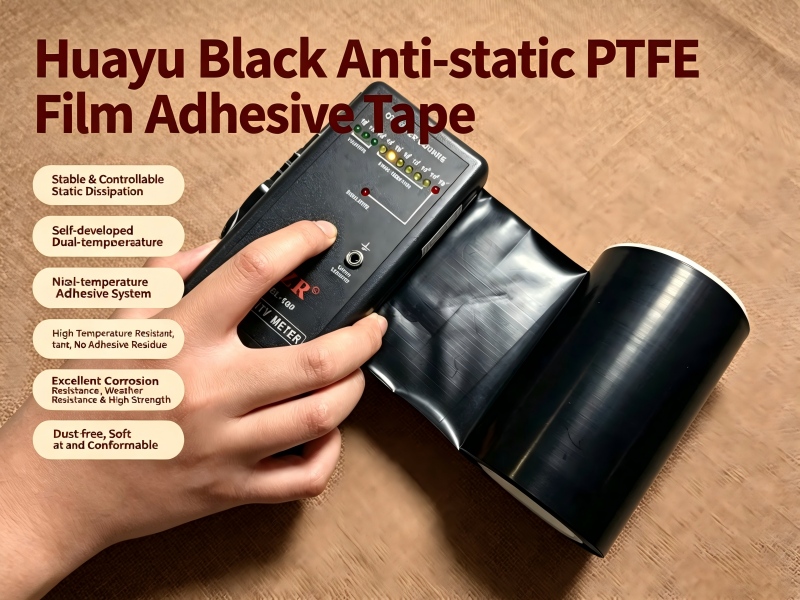
Key Product Advantages
1. Controlled & stable anti‑static performance: Surface resistance 10⁷‑10⁸ Ω/sq for gradual static‑charge dissipation. Prevent local static accumulation and electrostatic discharge damage for sensitive components. Resistance stays uniform over whole roll with small drift under temperature variation, partial static‑failure is minimized.
2. Rich adhesive portfolio: Two grades of acrylic adhesive are available: standard acrylic (150 °C), self‑developed high‑temp acrylic (260 °C, benchmarked against Henkel Germany), plus silicone PSA to cover diversified process requirements.
3. Excellent heat‑resistance: Maximum continuous operating temperature ‑70℃ ~ 260℃ (depends on adhesive selection), transient peak temperature up to 280℃. Film resists embrittlement under hot‑cold cycling; premium adhesive resists delamination and thermal ageing.
4. Non‑stick & clean peeling: Low‑friction PTFE surface delivers outstanding anti‑adhesive property. Minimal adhesive residue after peeling from work‑pieces for repeated masking‑release operations.
5. Chemical‑resistant & ageing‑proof: Resistant to strong acids, alkalis, organic solvents, oil and moisture. Waterproof, oil‑proof and UV‑weather‑resistant for long‑term operation in corrosive environments.
6. Soft & excellent conformability: Flexible pure‑film substrate bends freely for wrapping curved rollers and irregular‑shaped work‑pieces. Lays flat without edge‑lifting. No fiberglass dust shedding, suitable for clean‑room environment.
7. Multiple thickness options: Custom slitting available for different roll widths.
Selection Instructions for Three Adhesive Systems
1 Conventional Acrylic‑Adhesive Anti‑Static PTFE Film Tape
‑ Core features: Good initial tack, firm bonding and cost‑effective; maximum service temperature: 150℃.
‑ Applications: Medium‑low‑temperature static‑protection, roller wrapping, surface protection for chemical equipment, short‑term masking & fixing.
2 Self‑Developed High‑Temperature Acrylic‑Adhesive (Benchmarked against Henkel Germany)
‑ Core features: Huayu proprietary modified acrylic formula, long‑term temperature resistance up to 260℃. Compared with silicone adhesive, it has extremely low silicon‑outgassing risk to avoid silicon contamination while maintaining stable adhesion and anti‑delamination performance under heat.
‑ Applications: High‑temperature manufacturing processes where silicon‑outgassing contamination must be avoided; selected reflow‑soldering, hot‑press and precision‑electronics ESD‑protection processes sensitive to silicon contaminants.
3 Silicone‑Adhesive Anti‑Static PTFE Film Tape (Main Selling Grade)
‑ Core features: High‑temperature resistance up to 260℃ with excellent weathering performance. Better resistance‑value stability under elevated‑temperature conditions.
‑ Applications: High‑temperature manufacturing processes, hot‑roller wrapping, masking for wave‑soldering peripherals, high‑temperature ESD‑protection and frequent peel‑and‑reuse scenarios (silicon‑outgassing acceptable).
Main Application Scenarios
1 ESD Static‑Protection for Semiconductor & Electronics Manufacturing
Laminated on fixture plates and tooling surfaces inside clean‑rooms. Dissipate static charge generated by friction gradually, avoid electrostatic‑discharge damage to chips and sensitive electronic components. Free of fiberglass shedding to reduce particulate contamination risk. Choose self‑developed high‑temperature acrylic grade to eliminate silicon‑outgassing concerns.
2 Anti‑Static Wrapping for Hot‑Press & Conveyor Rollers
Used to wrap rollers for laminators, heat‑sealing and compounding machines. High‑speed roller rotation easily builds static electricity; this tape eliminates static‑spark hazards, meanwhile leveraging PTFE non‑stick property to prevent material adhesion on roller surfaces. Prefer self‑developed high‑temperature acrylic adhesive if silicon contamination is not permitted.
3 High‑Temperature Anti‑Static Masking for SMT Processes
Covers jigs and tooling peripherally for wave‑soldering and reflow‑soldering. It delivers both high‑heat‑resistance & non‑stick performance, while suppressing static electricity generated by tool friction to protect circuit‑board components. Select high‑temperature acrylic PSA for silicon‑sensitive soldering applications.
4 Liner for Chemical‑Powder Chutes & Hoppers
Powder material flow creates friction‑induced static charge. Lining hoppers and chutes with anti‑static PTFE film tape dissipates static and mitigates fire‑ignition risk. Excellent chemical‑resistance and non‑stick performance reduce powder caking and material buildup.
5 Tooling Protection for New‑Energy Lithium‑Battery Production
Applied to fixture surfaces, baffles for lithium‑ion battery manufacturing. Controls static discharge to prevent static‑induced damage to electrodes and battery cells, suitable for tooling protection during hot‑press forming processes. Prefer self‑developed high‑temperature acrylic grade for strict silicon‑outgassing control.
6 Special‑Purpose Demoulding & Isolation for High‑Temperature Work
Used as release‑isolation layer for rubber and plastic hot‑press forming. It provides demoulding non‑stick performance plus static‑dissipation to prevent dust adsorption by static electricity, well‑suited for precision composite‑material thermal‑processing.