


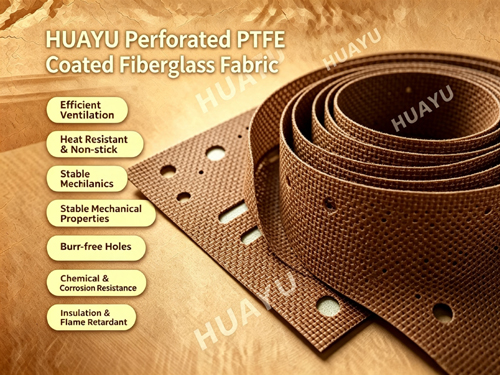
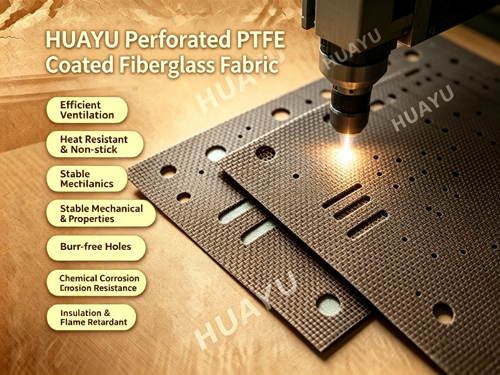
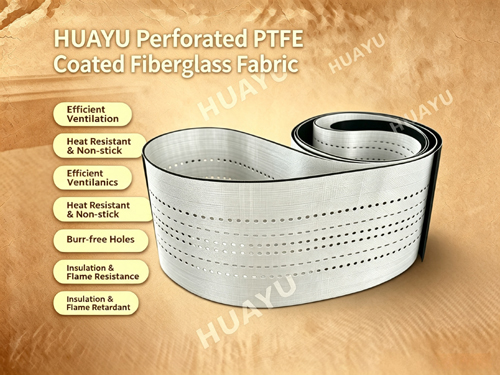
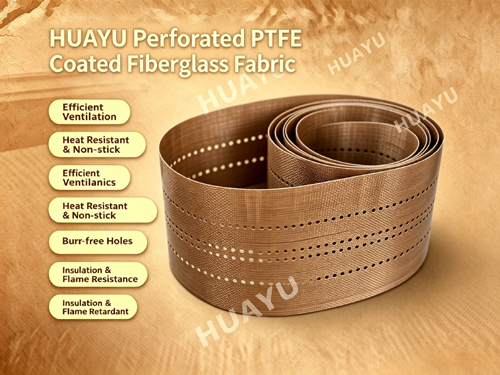
HUAYU Perforated and Cut-to-size PTFE Coated Fiberglass Fabric is made of high-purity electronic-grade fiberglass fabric, impregnated with imported PTFE emulsion and sintered repeatedly at high temperature. It supports laser perforation, die punching, precision cutting and special-shaped processing. The aperture, hole pitch, hole arrangement and overall dimension can be customized according to customer drawings.
This material features an ultra-wide temperature resistance range. The modified formula enables stable long-term service from -140℃ to 360℃, withstanding a short-term peak temperature of 380℃. It combines non-stick property, air permeability, heat dissipation, corrosion resistance, high tensile strength and stable insulation. The perforated structure rapidly exhausts trapped air, vapor and volatile substances during lamination, hot pressing and curing, effectively eliminating defects such as bubbles, delamination, incomplete filling and bulging. All finished parts are pre-shaped and ready to use without secondary processing, perfectly matching automated production lines.
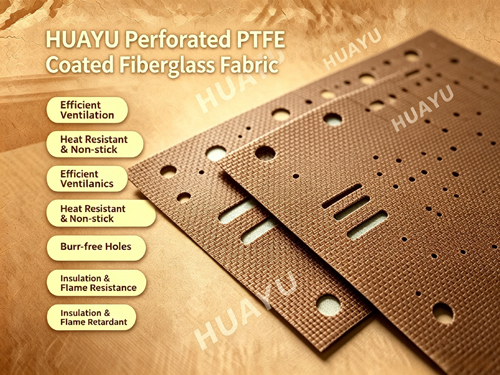
Technical Specifications
Item | Parameter |
Base material | Electronic-grade fiberglass cloth (7628 available) |
Coating | PTFE (Polytetrafluoroethylene) |
Thickness options | 0.08mm、0.13mm、0.18mm、0.25mm、0.30mm、0.35mm、0.40mm、0.60mm、0.70mm、1.0mm(custom thickness available) |
Temperature resistance | Long-term:-140℃~360℃ ;Short-term peak:380℃ |
Surface property | Non-stick, low friction, acid & alkali resistant, solvent resistant |
Dielectric strength | ≥3KV/mm |
Standard colors | 咖啡色、黑色、灰色、白色 Brown, black, gray, white |
Perforation method | Laser perforation / die punching |
Aperture range | 0.5mm~10mm( customizable) |
Hole pitch | Custom layout as per drawing |
Machining tolerance | Cutting ±1mm, aperture ±0.1mm |
Flame retardancy | UL94 V-0 |
Supply form | Finished cut pieces, special-shaped parts, processed rolls |
Key Features
1. Ultra-wide temperature tolerance: Flexible and non-brittle at -140℃, stable at 360℃ long-term, no shrinkage, delamination or deformation; withstand instant thermal shock up to 380℃, suitable for extreme thermal cycling.
2. Superior air permeability: Uniform holes quickly discharge vapor and volatiles, greatly reducing bubble defects in PV, composite and lithium battery hot-pressing processes.
3. Excellent non-stick performance: Dense PTFE coating repels resin, EVA and adhesive, delivers clean demolding and allows repeated use.
4. Chemical resistance: Resists acids, alkalis, release agents and oil, anti-aging and no powdering under continuous high temperature.
5. Complete thickness lineup: Thin grades for fast light pressing; heavy-duty grades of 0.3mm–1.0mm feature high compression & tensile resistance for long-time high-pressure curing and lamination.
6. High-precision custom processing: Special shapes, hole arrays and positioning holes are available to fit automated tooling.
7. Reliable insulation: Stable dielectric performance under high temperature, ideal for photovoltaic, electronics and precision pressing.
Application Scope
1. Photovoltaic Industry (Core Application)
Used as breathable separator cloth for solar module lamination. Holes fully vent volatile gas released by EVA during high-temperature lamination to avoid bubbles, insufficient lamination and delamination, improving product yield. Thickness ≥0.3mm is recommended for high-pressure long-cycle PV production lines.
2. Lithium Battery & New Energy Industry
Applied for cell hot pressing, module shaping, electrode lamination and drying. Perforations release internal pressure to prevent cell bulging, while isolating heating plates for anti-stick and anti-contamination protection.
3. Carbon Fiber & Composite Material Curing
For vacuum pressing and molding of carbon fiber prepreg, fiberglass and resin-based composites. Efficiently exhausts air and excess resin to produce dense, smooth parts free of pinholes.
4. PCB & CCL Lamination
Serves as breathable isolation cushion for prepreg and circuit board hot pressing, preventing resin overflow adhesion and stabilizing flatness and yield.
5. Rubber & Silicone Vulcanization
Used in high-temperature vulcanization and hot forming of rubber and silicone. Ventilation and non-stick property eliminate surface bubbles, indentations and sticking defects.
6. Cryogenic & Alternating Temperature Conditions
Works as gaskets for cryogenic equipment and thermal cycling systems. It remains flexible and crack-proof at -140℃ for extreme industrial working conditions.
Summary of Advantages
Full range of thickness options, ultra-wide temperature resistance, custom perforation & cutting, stable ventilation, durable non-stick surface, anti-aging, compatible with automated equipment and drawing-based customization. It is a premium long-life breathable isolation material for photovoltaic, new energy, composite and precision electronics industries.